
On Visiting Dealey Plaza
I cross an item off my bucket list. It was anti-climatic.

Recently, I had the opportunity to cross something off my bucket list, though it was hardly a joyful experience. That wasn’t because I didn’t enjoy the event (it was fulfilling in that crossing things off your bucket list way) or because it was anti-climatic. It had everything to do with the circumstances that led up to the experience1.
Today’s post is about going to Dealey Plaza.
I thought I knew Dealey Plaza pretty well. I wasn’t prepared for how little “there” was there despite having seen it on the screen many times and having thought about it for years.
Like most Americans who either lived through the event or learned about it in school or through Oliver Stone’s film JFK, I knew that President John Fitzgerald Kennedy aka JFK was assassinated in Dealey Plaza. And like most people who hear about how it happened, I immediately questioned how the work knew what it claimed to know and if that’s how it really went down.
I don’t recall when I first saw the film JFK. I think I may have been in my late teens or early 20s and probably saw it prior to 2004. (The film came out in 1991.)
I wondered how much of the film was Hollywood bullshit and how much was real.
As I later got interested in history, the JFK assassination was always on my list of events to research, but it didn’t make it to the top of my list until I came across Erich Hunley and Mark Groubert’s America’s Untold Stories2.
Groubert wrote a 5 part, 10 hour miniseries for Oliver Stone on Oswald, called, conveniently enough, Oswald. Stone & Co. never produced the miniseries, but after partnering with Eric Hunley and starting America’s Untold Stories (which started with Groubert going through the assassination character by character, Hunley leaned on AI–Specifically ElevenLabs–to voice an audio drama3.
Because of America’s Untold Stories, I started reading what I could about the assassination.
I had been to Dallas once before for a block party–twenty years ago. At the time, I didn’t put two and two together that Dallas was the city where Kennedy had been assassinated. It wouldn’t have mattered because I barely had the money to fly out and back, much less rent a car and drive to Dealey.
This time around, I still had no money; seems to be a recurring theme.
I was heading to Dallas for other reasons; my destination was roughly a mile from Dealey. There was no way I could pass up the opportunity to see Dealey being that close to it, so I set my GPS for Dealey.
I thought I knew Dealey Plaza pretty well. I wasn’t prepared for how little “there” was there despite having seen it on the screen many times and having thought about it for years.
The Dogleg Turn from Houston onto Elm
The first thing I noticed was that the turn from Houston onto Elm didn’t seem nearly as acute as I had seen it depicted on film or in documentaries. Perhaps it wasn’t as dramatic, in part, because I was in a modern, short car, not the long Presidential limousine. It turns out the geometry has not significantly changed since 1963.
The Schoolbook Depository/Sixth Floor Museum
I did not visit the museum for a few reasons:
I couldn’t afford the parking
I knew if I couldn’t afford the parking, I couldn’t afford the ticket to the museum
I don’t believe Oswald acted alone. In fact, I don’t believe that Oswald shot anyone that fateful day.
Groubert took Hunley to the Sixth Floor Museum and was explaining how he believed events played out. Groubert mentioned this event on America’s Untold Stories, stating that the museum visibly disagreed with his explanation of events. So I knew I wasn’t interested in giving the museum my money nor listening to their presentation.
Parking
If you do decide to visit Dealey, be prepared to pay the Sixth Floor Museum’s fees. Or you could park at the jail/courthouse a few blocks away and walk, which is what I did. Cost me $4.
And no, this is NOT the parking garage that Oswald was shot in. As I understand it, that garage is now part of a law school.
Walking
In 1963, the motorcade was traveling towards the triple underpass moving from east to west. They turned west onto Elm from their northern route on Houston.
Walking to Dealey from the parking garage, I was on the north side of Elm. Ergo, if the motorcade had been on its route, I would have been walking towards it and it would have been driving towards me.
There were two people sleeping rough on the sidewalk of the north side of the triple underpass. I chose to walk on the south side of Elm for my return because I had crossed Elm to look at the statue of Dealey on Commerce street.
Dealey Plaza Itself
There’s a plaque that has part of the speech Kennedy was going to give at the Trade Mart had he made it to that speaking engagement. I think there’s one small plaque that mentions the assassination. Other than that, nothing.
I recall Groubert telling the America’s Untold Stories audience that Dealey was much smaller than you think it is. According to Grok, the official distance from the so-called dog-leg corner of Houston and Elm to the triple underpass is 495 feet. You can walk that distance in two minutes or less even while sauntering. You either have to stop or take baby steps the whole way to not cover the distance. That stretch of road is small. Even being forewarned by Groubert, I was still shocked at just how small Dealey is.
Confusing Geography
I drove through the plaza more than once because I was unfamiliar with the area. The so-called Stemmons Freeway is actually I-35. If you’re in the right-hand lane, you wind up going I-35 East if you stay right, but there isn’t much room to avoid getting on the Interstate if you’re already on the right (read: North) side of Elm.
Two X’s?
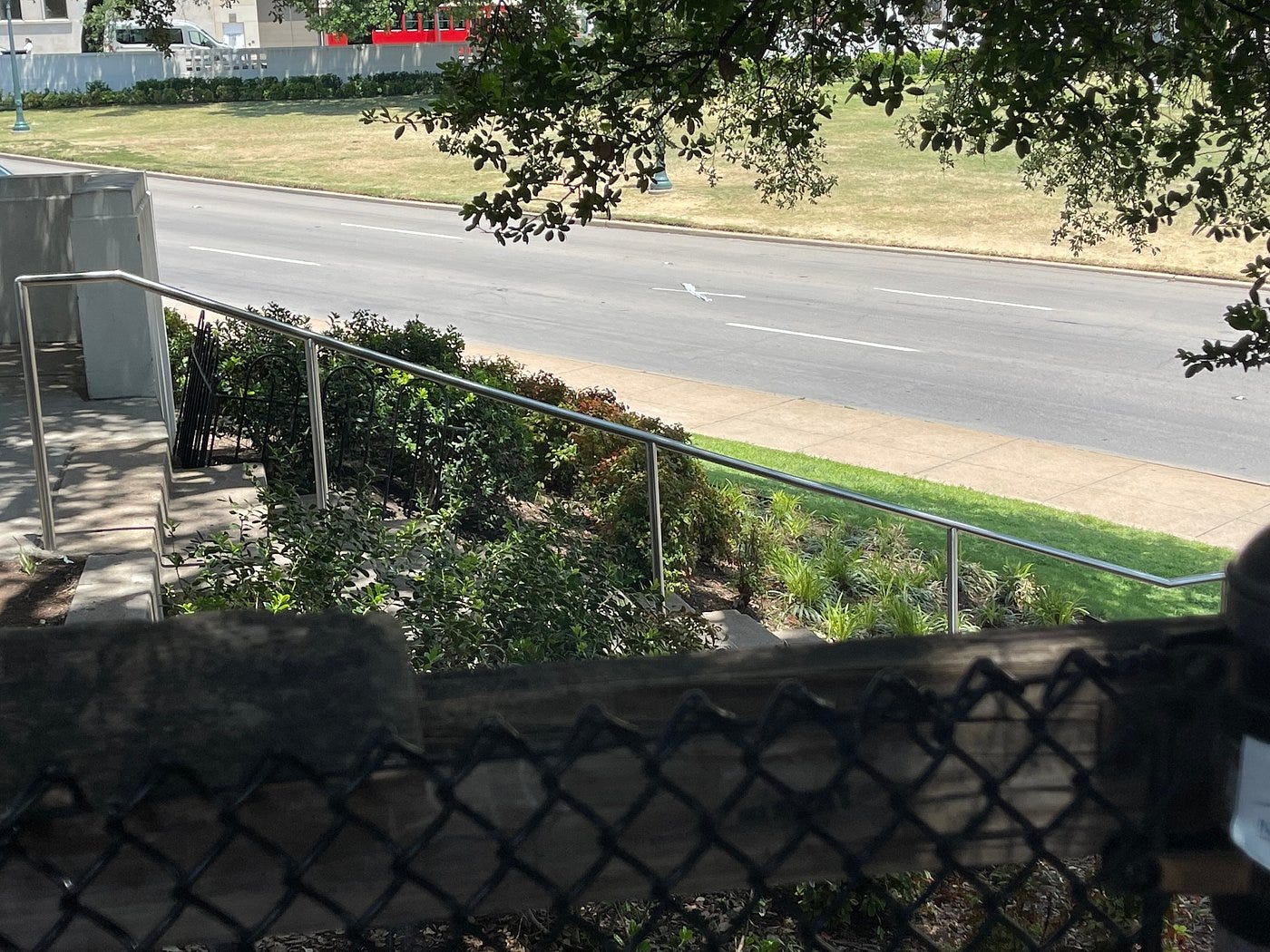
If you look at the hero image of this post, it’s taken from behind the picket fence which is on top of the Grassy Knoll. All that means is that there was a slight hill on the north side of Elm and the picket fence was to the west of the grass. Behind the fence is a parking lot just like it was in 1963.
I draw your attention to the hero image of this post because if you look in the middle of the image, you’ll see an X in the middle of the middle lane. (NB: Lots of middles.)
That X marks the approximate spot where Kennedy was fatally shot.
I knew there was an X on Elm because of interacting with some of the Unstructured Locals community members. It’s also possible I came across that fact before I was aware of America’s Untold Stories and forget I knew there was an X marking the spot.
What I wasn’t prepared for was this:
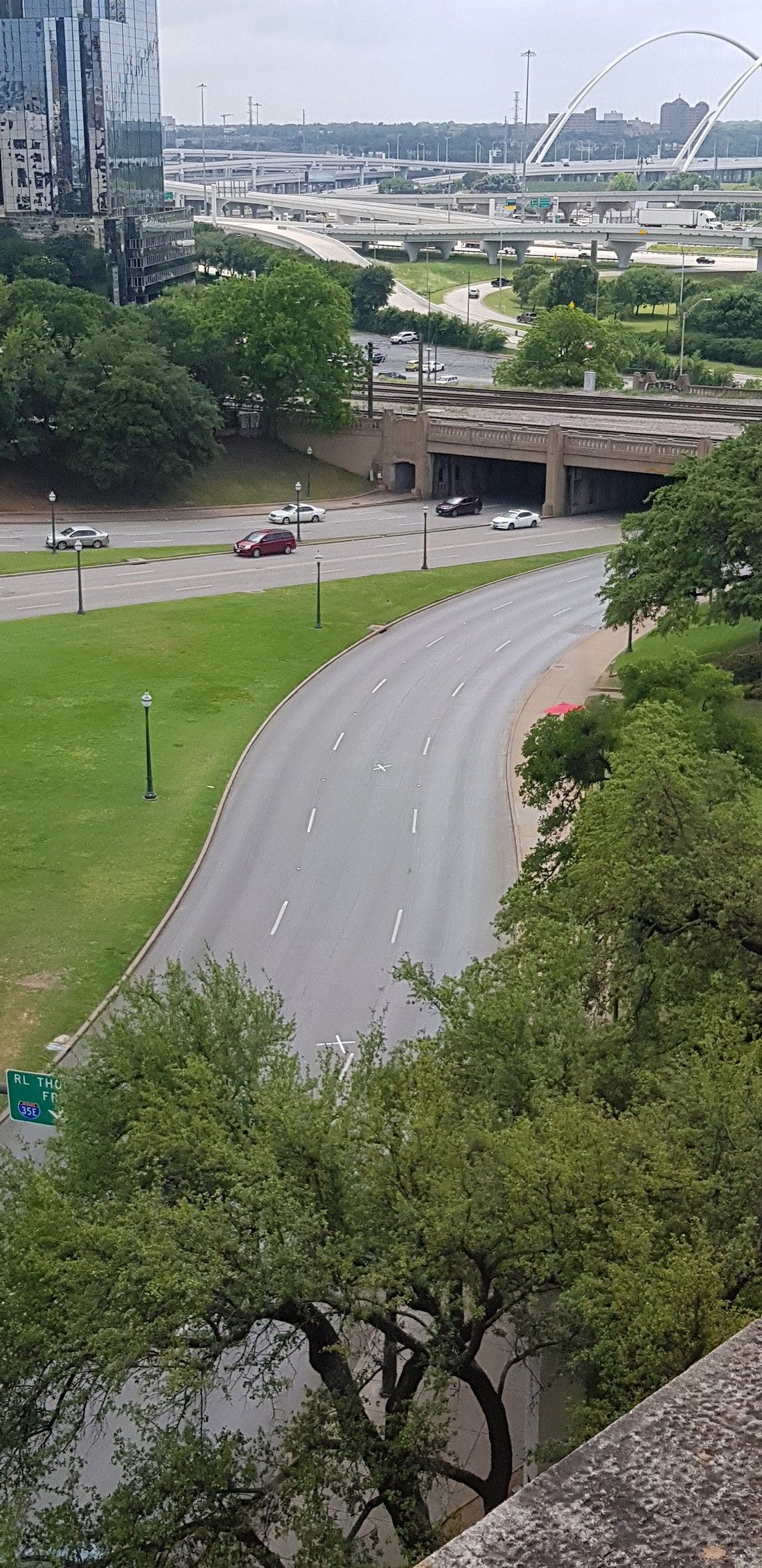
There were two x’s on the road when I visited the site.
In the image immediately above, the x that is slightly obscured by the tree and is closer to the lane marker is allegedly where Kennedy was first shot.
As I stated earlier, there was no plaque that tells visitors what these x’s are.
In fact, the x’s aren’t official. They aren’t maintained by the city or any government organization. In fact, the road has been resurfaced since November 22, 1963, so the x’s have been removed and replaced. I recall reading somewhere months or years ago that the x’s get refreshed from time to time, but no one knows who; my money is on the Sixth Floor Museum.
According to Grok, the distance between the two x’s is 80-90 feet.
Dealey Over the Years
Dealey Plaza–the roads, the hills, the grass and the colonnades/peristyles are geographically unchanged from 1963. In fact, Dealey was remarkably preserved from November 22, 1963 even as late as 1990 when Oliver Stone shot part of JFK in the Plaza for nearly 3 weeks. There were some cosmetic adjustments made: some vegetation trimmed to more closely match sight lines in 1963, a replica Hertz sign had to be put “back” on top of the Book Depository. The production had to pay for traffic to be diverted during their shoot.
Elm is very much an active road today.
Perhaps there are more homeless people under the triple underpass than there were in November of 1963.
Final Thoughts
Standing there on Elm Street finally allowed me to more accurately understand the place itself–a stark contrast with how large it has loomed in my mind for years.
When I return to the case files, I’ll be able to picture the geography of the crime scene much more clearly.
I am calmly content with this result.
I still owe subscribers an email about this.
Foley–that is to say, sound effects–were part of the production as well to make the audio drama a “real” audio drama instead of just dialog. If memory serves correctly, James Tape Damage provided the sound effects. If you become a paying member of their Locals (https://unstructured.locals.com/), you can listen to all five parts.